
As part of my journey in amateur radio, I maintain an OpenWebRX+ station for remote radio reception. The idea is simple: to make a small window into the radio spectrum available through the internet, allowing me — and other interested listeners — to monitor selected radio bands directly from a web browser, without installing any specific software.
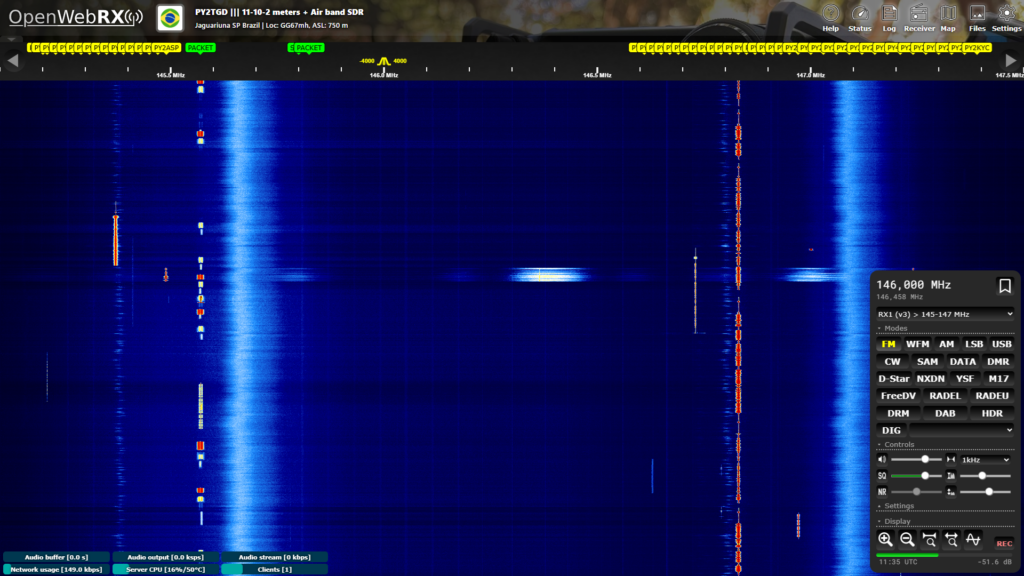
The station is identified as PY2TGD — HF / VHF SDR and operates from Jaguariúna, São Paulo, Brazil, at grid locator GG67mh. It currently uses two SDR receivers covering selected portions of the 11-meter, 10-meter, 2-meter and airband spectrum. To open the SDR click here or check the menu bar.
Station setup
The current setup is intentionally simple and experimental, but already quite useful for radio listening, propagation observation and digital signal monitoring. One receiver is based on an RTL-SDR Blog V3 connected to a Steelbras AP5249 VHF 5/8-wave antenna. The second receiver uses an RTL-SDR Blog V4 connected to a DIEX rigid dipole for the 10-meter band.
OpenWebRX+ turns this hardware into a web-accessible receiver. Through the browser, it is possible to view the waterfall, tune within the configured profiles, select demodulation modes and monitor radio activity in real time. It is a very practical way to observe band behavior, compare signals and better understand radio propagation.
Available features
In addition to conventional listening modes such as AM, FM, SSB and CW, the station is also configured to support the reception and identification of several digital modes and monitoring activities commonly used in amateur radio:
- APRS, for packet reception and station tracking;
- FT8, for observing digital activity and propagation;
- WSPR, useful for propagation analysis and weak-signal monitoring;
- SSTV, allowing the reception of images transmitted over radio;
- airband monitoring, within the configured reception limits.
At certain times, some receivers or profiles may be locked or dedicated to specific automatic decoding tasks. This is part of the purpose of the station: more than just a remote receiver for manual tuning, it also works as a small continuous monitoring platform.
Why maintain an OpenWebRX+ station?
For me, the main value of this project is learning. An OpenWebRX+ station combines radio, antennas, SDR, Linux, networking, digital modes and propagation into a single practical environment. Every improvement in antenna position, receiver configuration, profile design or system stability brings new observations and technical lessons.
I also see this type of station as a modest but useful contribution to the radio community. Even a simple installation can help other operators and listeners check signals, observe propagation openings or explore modes they may not yet be familiar with. It is a practical way to share part of the station infrastructure with people who have a technical interest in radio.
An evolving project
Like most amateur radio projects, this OpenWebRX+ station is constantly evolving. Reception quality depends on many factors: antennas, feedlines, local noise, propagation, receiver load, network availability and software configuration. For that reason, I consider this station a living environment, open to adjustments, experiments and occasional downtime.
Even so, it already serves its purpose well: supporting experiments, recording experiences, monitoring signals and keeping another learning path open within the hobby. It is a small public SDR station, but a valuable tool for study, experimentation and spectrum observation.
73 and good DX!